
Pricing
Strategy Consulting Delivered as Software + Services
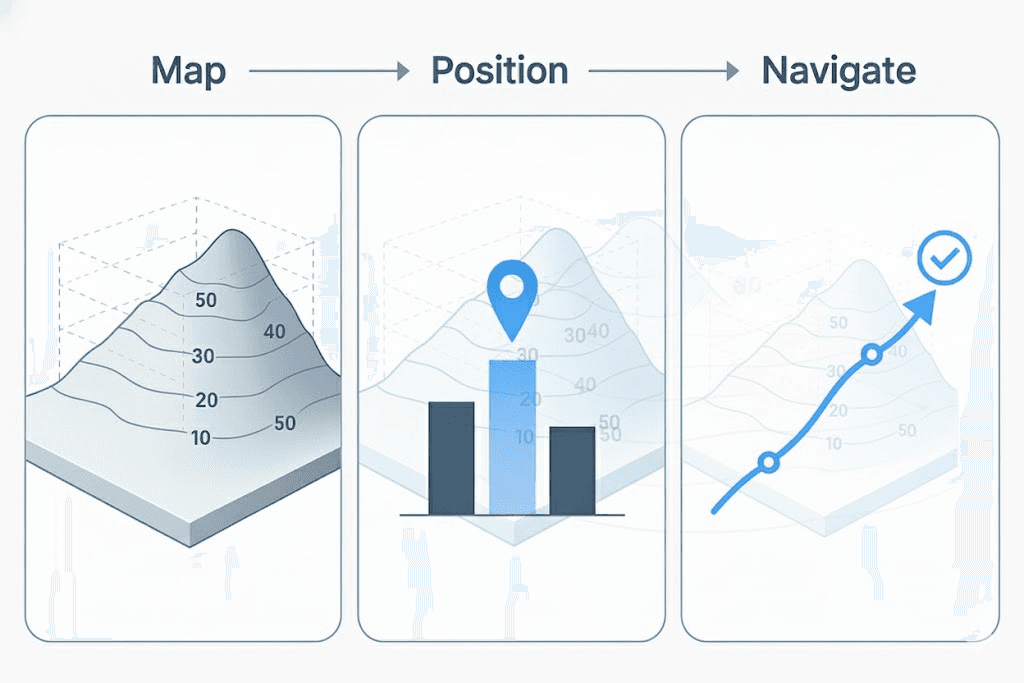
- Map the entire AI Supply Chain with Industry Benchmarks→
- Position where a specific player stands with Company Scorecards→
- Navigate to close the gaps and get ahead with Strategy Playbooks→
Benchmarks is the Map layer: it gives a decision-maker a defensible, scoped, evidence-backed view of "what average looks like" for a specific solution area. Benchmarks establish the landscape under explicit context (geo/time/industry/provider).
Then (and only then) Scorecards and Playbooks become meaningful.
Scorecards (Position): place a specific company onto that map using private inputs + standard variables.
Playbooks (Navigate): prescribe and simulate moves from current → target state, with tradeoffs and ripple effects.
1. BenchmarksWhat is the map?
SOFTWARE
SERVICES
- Per-Solution Area benchmark dashboards (choose from the 12 AI Supply Chain solutions).Solution Area
- Standard context overlays included (industry, geography, time period); add overlay packs as needed.Overlay Packs
- Variable catalog with definitions and dependencies (state-space model).
- Percentiles and distributions (p25/median/p75), trends and cohorts.
- Evidence traceability and data lineage for every metric.
- Uncertainty/confidence bands on key variables.
- Re-run support and change tracking (longitudinal benchmarking).Refresh Cadence
- Exports; optional API for internal BI tools.API / Export
- RBAC and audit logs; SSO/SAML on higher editions.SSO/SAML
- Overlay customization and cohort design (regions, model cohorts, competitor sets).Service Credits
- Third-party dataset sourcing, licensing, and normalization.Service Credits3rd-Party Data
- Analyst walkthrough and quarterly insights memo.Service Credits
- Domain-expert validation session(s).Service Credits
- On-demand refresh SLAs beyond standard cadence.Service CreditsRefresh Cadence
- Team training workshop; enablement materials.Service Credits
- Procurement/security support (DPA, questionnaires).Service Credits
2. ScorecardsWhere are we on the map?
SOFTWARE
SERVICES
- Secure company workspace for each entity (company/site/BU).
- Data ingestion connectors and schema mapping to state variables.API / Export
- Entity scoring vs. benchmarks; gap analysis (strengths / weaknesses).Entity Packs
- Multi-entity comparisons; alerts on material deltas.Entity Packs
- Uncertainty propagation into scores; sensitivity highlights.
- "What-if" lite toggles before full Playbooks.
- Exports and API; integration with internal BI/datamarts.API / Export
- Roles: Analyst / Viewer / Admin; approvals and audit trail.Analyst Seats
- RBAC, data isolation, SSO/SAML.SSO/SAML
- Data onboarding and quality remediation (ETL/ELT help).Service Credits
- Variable/KPI definition workshop; mapping internal metrics to the model.Service Credits
- Analyst-led scorecard build and interpretation.Service Credits
- Executive snapshot with prioritized actions and risks.Service Credits
- Custom variables or domain-specific modeling schemes.Service CreditsCustom Modeling
- Managed operations (we run the scorecards for you).Service CreditsManaged Operations
- Training for internal analysts; governance/permissions design.Service Credits
- Integration help for BI/OKR workflows and reporting cadences.Service CreditsAPI / Export
3. PlaybooksHow do we navigate to the destination?
SOFTWARE
SERVICES
- Scenario design and simulation engine (deterministic + stochastic) with parameterized levers and constraints.Scenario PacksSimulation Scale
- Scenario comparison and ranking; sensitivity analysis.Scenario Packs
- Confidence bands and evidence traceability carried into outcomes.
- Versioning and approvals; run management with compute guardrails.
- Program tracking: actions, milestones, impact projections; report builder.
- Collaboration (notes, comments); API for planning/ERP tools.API / Export
- Starter domain templates (e.g., Tariff Shock, Dual-Sourcing).Template Packs
- Playbook design workshop; decision framing and levers.Service Credits
- Model calibration and validation with domain experts.Service Credits
- Scenario sprints run by our analysts; decision memos and board-ready materials.Service Credits
- Wargaming / red-team sessions for critical decisions.Service Credits
- Value tracking and benefits realization; KPI instrumentation.Service Credits
- PMO / change management to drive adoption.Service Credits
- On-call Scenario Desk (urgent decisions) and quarterly strategy reviews.Service Credits
- Custom simulation modules; partner co-delivery with your preferred consultants.Service CreditsCustom Modeling